
Several million years ago, when the earth was still molten and bubbling, Mpumalanga province, Republic of South Africa, is where rocks began to solidify, and terra began to become firma. Forward millions of years, when Adam and Eve, and Lucy, moved into the nearby neighborhood. Forward again to the mid-19th century when the Voortrekkers (Dutch) began consolidating in the area, then known as the Transvaal, and ignited the Boer wars. Finally, the Voortrekkers established their seat of government in Pretoria in 1902, and de facto, became the center of apartheid. (Ironically, for many years, the president, who lives here, as well as the mayor, has been black.) Now, 108 years after that, is where you find me, reporting my travels to you from the cradle of history.
The Peace Corps set up an appointment for me in Pretoria for Wednesday afternoon. Transportation being what it is here, I traveled to Mbabane on Tuesday by bus, did a little paper-work in the PC office and was put up in a shabby guest house for the night. Promptly at 7:30 a.m., I was picked up by a PC driver and we began a gradual climb to the west, up the Drakensberg escarpment (of one thousand meters), arriving at the Pretoria PC compound about three and a half hours later.
I was impressed with Pretoria; a bustling city with signs of modernity and good infrastructure, but with large jacaranda trees shading even the business routes. The PC office is near Embassy Row and the University of Pretoria. Unfortunately, I didn’t have any time to spend investigating the city, but my overall impression was good. After my appointment, I was taken to my guest house (B&B) which was in an upscale neighborhood with nice homes behind large, solid fences, and old trees growing in the parking strips (maybe from the same period as the Magnolia district). I walked about two km through the neighborhood on concrete sidewalks to get to “Brooklyn Mall”, an older American-style mall, where I had a nice dinner. Back in my comfortable room, I even enjoyed some tv (the local channels were in Africaans), and I was able to drink the water right out of the tap. (I can sense your excitement.) Besides myself, there were about eight other PCVs from various countries in Africa and I enjoyed visiting with them. It’s interesting to note that three of us were from Washington State and a fourth was from Portland.
The next day, my driver picked me up and we got on the toll-way to retrace our route. The suburbs of Pretoria that I saw reminded me of the suburbs of Vancouver B.C., with similar homes, closely set, with an air of British about them. The road was very nearly American freeway standards; two tolls, R24 and R39, or the equivalent of about US$9 took us almost two hours away where we left the toll-way for the equivalent of a county road toward Swaziland. The highveld is flat or softly undulating green fields with the horizon far away. I saw hectares of maize, large herds of healthy cattle (in contrast with the few, scrawny, free ranging cattle of SD), and farther away, I saw mountains of coal out one side of the car, while out the other side were numerous cooling towers suggesting nuclear power plants. Closer to SD, we drove by pseudo-forests (man planted), a significant cash crop for the area. When we left the toll-way, the land began rolling more and more until we were back to an ancient sandstone of some type—some of it as huge boulders resting on top of each other, other times just breaking the surface, making smooth bald spots in the green fields. Passing that, and as we neared the border, it began to look more like SD; the rolling hills became mountains and valleys, the horizon drew nearer, and the brick huts gave way to the classic beehive rondevals. The border check was painless (you get out of your car and go inside rather than being checked while in your vehicle) and my driver took me directly to the Mbabane bus ranks where I caught my bus back to the 1940s.
Sunday, January 23, 2011

Sunday, January 16, 2011
THIS WEEK IN SWAZILAND
Last Sunday, we had three guests from Good Shepherd visit us. We had good conversation, enjoyed a game of Quiddler, and generally had a good time. When supper time came, the power went down. Mo had made a couple of salads, and we had cheese and crackers, and we had enough wine in us so nobody missed the fact that we couldn’t prepare any meat for the meal. Power was restored about the time they left.
Monday, three PCVs came to help me re-arrange books in the library. The water had threatened to go out early in the day, but we finished our work and most of us showered after moving the dirty books—except for one who deferred. They did a great job and over-nighted with us.
Tuesday morning, we got up and had no water service. Well, we had running water of sorts—it was running out of the attic area onto our eating table. And the girls had all moved into the living room after hearing strange ‘animal noises’ in their bedroom ceiling. Yet, we had French toast, ‘bacon’, and coffee/tea for breakfast. Our filtration apparatus holds over four liters, so we have some margin; we also have some reserve in PC-issue containers. One of our guests wasn’t able to shower before she left. Bummer.
The next day, we had no water service, but Mo and I were both busy working on our projects. Late afternoon, I went for a run, and when I returned, I found Mo finishing washing a load of clothes. Obviously, we had water. So I joined her. Our wash tub is built-in, just outside the back door—cold water only, and about knee high. After washing the clothes, we do two rinses to get rid of the soap. Each piece is rinsed and then rung out and put aside for the next step. The water had been down so long that it was murky and tan. The second rinse wasn’t much better. It is back-breaking, time-consuming work. Finally, we hung the clothes on the line, sheets and shirts on the outside so that we could hide our sox and underwear on the inside, for propriety sake.
So the clothes were on the line over night and, typically, we had rain.
Thursday night, we had another spectacular lightning storm, so it was no surprise that when we got up Friday morning, we had no water, we had no power, and we had no internet service.
Saturday we slept in but were awakened by bright sun, and we had water, and we had power, and we had internet, and we were even able to Skype (Good to visit with you, Jim). A not unusual week here in the 1940s. Americans, count your blessings.
Monday, three PCVs came to help me re-arrange books in the library. The water had threatened to go out early in the day, but we finished our work and most of us showered after moving the dirty books—except for one who deferred. They did a great job and over-nighted with us.
Tuesday morning, we got up and had no water service. Well, we had running water of sorts—it was running out of the attic area onto our eating table. And the girls had all moved into the living room after hearing strange ‘animal noises’ in their bedroom ceiling. Yet, we had French toast, ‘bacon’, and coffee/tea for breakfast. Our filtration apparatus holds over four liters, so we have some margin; we also have some reserve in PC-issue containers. One of our guests wasn’t able to shower before she left. Bummer.
The next day, we had no water service, but Mo and I were both busy working on our projects. Late afternoon, I went for a run, and when I returned, I found Mo finishing washing a load of clothes. Obviously, we had water. So I joined her. Our wash tub is built-in, just outside the back door—cold water only, and about knee high. After washing the clothes, we do two rinses to get rid of the soap. Each piece is rinsed and then rung out and put aside for the next step. The water had been down so long that it was murky and tan. The second rinse wasn’t much better. It is back-breaking, time-consuming work. Finally, we hung the clothes on the line, sheets and shirts on the outside so that we could hide our sox and underwear on the inside, for propriety sake.
So the clothes were on the line over night and, typically, we had rain.
Thursday night, we had another spectacular lightning storm, so it was no surprise that when we got up Friday morning, we had no water, we had no power, and we had no internet service.
Saturday we slept in but were awakened by bright sun, and we had water, and we had power, and we had internet, and we were even able to Skype (Good to visit with you, Jim). A not unusual week here in the 1940s. Americans, count your blessings.
Saturday, January 15, 2011
CELEBRATING THE NEW YEAR

After the departure of our Christmas guests, we set out on another new adventure, this time heading south-southwest on the MR9, the “Grand Valley road”. Back-packs packed, we caught an early bus, transferred in Manzini, rode to Nhlangano where Fred and Florence met us in time for lunch. From Manzini south was new territory for us and we enjoyed the views of the green hills and
 small mountains (although we did not enjoy riding in the bus—a little crowded, and Swazis have an aversion to open windows, even when the temp approaches the 30sC). We were impressed with the big city of Nhlangano. We saw sidewalks, curbs, and even traffic signals in a business grid with nice shops. Quite impressive when compared to Siteki. After lunch, we caught a Khumbi for another 20 minute ride to Mahamba and still walked 20 minutes more to their cabin. They have a very comfortable cabin in a beautiful valley setting—made me feel as if I was at a lake cabin. (They have
  electricity but no running water.) A little wine with supper and a little brandy ushered out the old year.
New Year’s Day, Fred and I climbed the ridge behind their home so we could look into Mpumalanga province of South Africa. Little did I know that I would be hiking with someone who is part mountain goat, whose legs are half again longer than mine, and is eight years younger. My keen eye estimated the elevation gain as 1500 feet (estimating pattern altitude) and we accomplished that in little more than 60 minutes. It was a beautiful day, much cooler on top, and I’ll let the photos speak for themselves.

The second picture is 'the gorge', where the Mkhondvo River enters Swaziland from RSA--and shows the elevation gain we climbed.
Third picture: The Palouse? No, the Mahamba Valley.
Fourth picture: Intersection in downtown Nhlangano, taken from inside KFC. The yellow vests are 6 per block everywhere in SD--selling air time.

The Mkhondvo River just after passing 'the gorge'. This is a camp
ground and the 'chalets' can be rented.

A view looking into the Republic of South Africa.

A typical homestead with rodeval in the middle and clothes on the
line.

Wednesday, January 12, 2011
CHRISTMAS IN SWAZILAND

Christmas seemed to be a very quiet holiday here in the kingdom. On Christmas Eve, Krista and Brian, and Kyra showed up to stay with us. (K & B have neither elec nor running water, Kyra has no running water.) After supper, we left them here at home to hang their stockings with care, while the two of us were picked up to go to a caroling and dessert party at Mabuda Farms. Picture 1 shows the threatening weather for Christmas Eve.
Picture 2 is the dessert table after candlelight caroling. Our invitation
 was at the behest of acquaintances at Good Shepherd Hospital. Mostly hidden behind Mike on the right is Dr Pons who owns Mabuda Farm and is the ophthalmologist at Good Shepherd (and the only one in the kingdom). Mabuda is 2.5 km from us; it has facilities for backpackers and is the largest dairy in the kingdom and has a beautiful setting.
Picture 3 is Christmas morning and
 everyone is checking his laptop for Christmas greetings. I made my usual pancake breakfast which Mo says I’m noted for. The breakfast isn’t unusual, but the ingredients are different. I start with coarse, dark Swazi flour; add brown eggs (we’ve never seen a white egg here—and there is frequently a surprise next to the yolk—are these fertilized eggs?); a little coarse, dark Swazi sugar; dilute with emasi (emasi is often compared to buttermilk but we liken it to quark which we discovered in Switzerland—more liquid than sour cream [which we can’t find here], but more solid than buttermilk). We top it off with honey or simple syrup (because we can’t get maple syrup locally—we just found some and brought it back from Nhlangano). They are served with “bacon” (which resembles thin, Canadian bacon that
  never crisps). Then, the five of us were picked up again for transport to Mabuda Farm.
Picture 4 is the grill at our braai on Christmas Day back at Mabuda. A picnic and braai is a typical celebration for Christmas here. Note the meats to the side of the grill which included wildebeest vurst (as well as pork, beef, chicken, and another wurst). It was cool and rainy so none of us got in the pool.

Picture 5: The buffet line. There were about 25 of us very loosely associated with Good Shepherd; we represented ten different English-speaking countries but, unfortunately, there were only about 4-5 host country nationals. So I guess you would say we had a white Christmas.

Picture 6 is a look into mid-veld Swaziland from Mabuda Farm—verdant after all the rain.
Picture 7: Right after our Christmas visitors left, Katie, Lauren, Shauna, and Daniel showed up. Unlike Christmas Day, the temperature was around 30C and humid so we finally got our time in the pool before bringing them
 home. This picture was taken of them after trying to keep up with Mo & Po and our stimulating conversation; only Shauna was conscious and is not in this picture. (The real reason for including this picture is so that Leonard can see his Merry Xmas banner hanging.) The day after they left, we departed for our New Year’s celebration which is the subject of my next blog.
Thursday, January 6, 2011
BASIC RISK MANAGEMENT 101


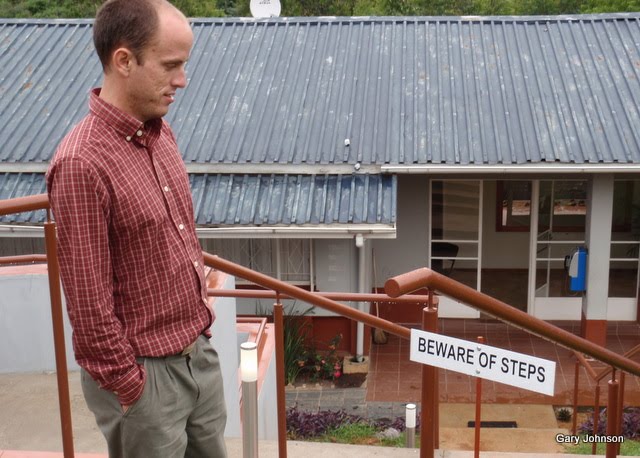
 Being married to a former Director of Risk Management is …well, an experience. Apparently, even in retirement, it ekes out of her system and alarms go off upon seeing hazards such as these which are commonplace around Siteki. Uneven surfaces and even holes
  in the sidewalks are left for the public to find—one way or another—without warning. The holes in the sidewalks are on busy thoroughfares (or there wouldn’t be a sidewalk) and the unprotected
  ledge is in front of the busiest store in town.

The contrasting pictures were taken at the Anglican Retreat Center in Mbabane where we recently had In-Service-Training. Subjects in the candid photos were caught observing the well-documented warnings, undoubtedly dictated by an alert Risk Manager.


Monday, December 27, 2010
: Two lessons: Geography and Birding
I’m writing this on the solstice; summer for us, winter for our readers (both of you). As I recall, that means the sun is 23 ½ degrees below the equator, and because we are about 26 degrees below the equator, at noon I will have to look between my feet to see my shadow. And living this close to the equator means we don’t get much variation in the length of our days. Sunrise is roughly 4:30 a.m. and sunset is around 7 p.m. today, and this is the longest day of the year. I do miss the late summer evenings of the Pacific NW.
This is being written by the non-birder. We have a nest of black collared barbetts (I’m told) right out our front door. We watch them come and go all the time. What makes it interesting is their call. Each bird has a short call of a single note, but they are sung antiphonally so it sounds like one bird, one tone about four notes below the other, kind of like a European siren, but higher, quicker and more musical. It makes me wonder, if they both chose the same tone, would it sound like _________ instead of -_-_-_-_-_.
During the mating season, the male of another bird grows very long tail feathers. It makes him a handsome fellow but upsets his flight characteristics so that he is nose high and the wings are working very hard. It reminds me of a student pilot who has seriously miscalculated his weight and balance.
We hear another bird which I think of as ‘the Swazi bird’. His call seems to wander aimlessly, never hitting or maintaining a pure tone, but smearing from tone to tone, like a drunken whistler. If you’re not sure why I call it the Swazi bird, read my blog on writing Swazi music.
Finally, I make frequent sightings of full-breasted mattress-thrashers; the African variety is darker than the American but is less shy about ‘displaying’.
This is being written by the birder. The birds here are plentiful, colorful and in general have pretty calls. I have forty plus birds on my Swaziland list and about thirty new birds on my life list without having had much time to go out in the “field” yet. The poor “flyer” that Gary mentions above is glossy black with a bright red collar during mating season. Non-mating season he is just a brown non-descript bird with a short tail. We have multiple bright yellow canaries that vie with the barbetts to wake us up in the morning. The ‘Swazi bird’ is elusive and has not yet been identified. I am making no comment about the Swazi mattress-thrasher.
This is being written by the non-birder. We have a nest of black collared barbetts (I’m told) right out our front door. We watch them come and go all the time. What makes it interesting is their call. Each bird has a short call of a single note, but they are sung antiphonally so it sounds like one bird, one tone about four notes below the other, kind of like a European siren, but higher, quicker and more musical. It makes me wonder, if they both chose the same tone, would it sound like _________ instead of -_-_-_-_-_.
During the mating season, the male of another bird grows very long tail feathers. It makes him a handsome fellow but upsets his flight characteristics so that he is nose high and the wings are working very hard. It reminds me of a student pilot who has seriously miscalculated his weight and balance.
We hear another bird which I think of as ‘the Swazi bird’. His call seems to wander aimlessly, never hitting or maintaining a pure tone, but smearing from tone to tone, like a drunken whistler. If you’re not sure why I call it the Swazi bird, read my blog on writing Swazi music.
Finally, I make frequent sightings of full-breasted mattress-thrashers; the African variety is darker than the American but is less shy about ‘displaying’.
This is being written by the birder. The birds here are plentiful, colorful and in general have pretty calls. I have forty plus birds on my Swaziland list and about thirty new birds on my life list without having had much time to go out in the “field” yet. The poor “flyer” that Gary mentions above is glossy black with a bright red collar during mating season. Non-mating season he is just a brown non-descript bird with a short tail. We have multiple bright yellow canaries that vie with the barbetts to wake us up in the morning. The ‘Swazi bird’ is elusive and has not yet been identified. I am making no comment about the Swazi mattress-thrasher.
Tuesday, December 21, 2010
A VERY MERRY CHRISTMAS TO YOU


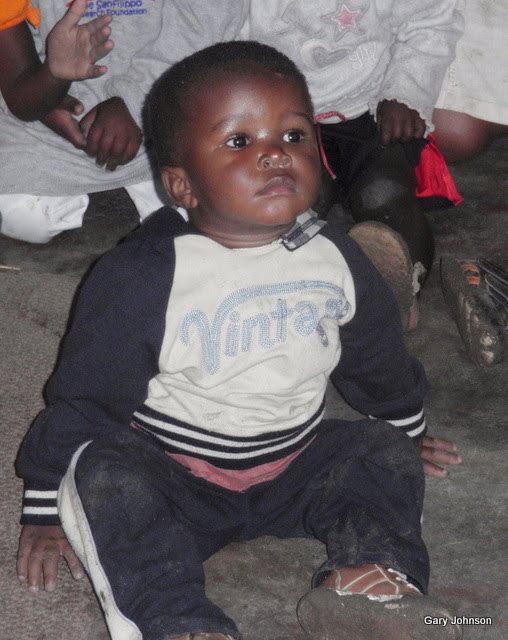


A few days ago, we had the opportunity to play Santa’s Helpers, arranged by Kathleen who volunteers at Good Shepherd in Home Based Care. We drove down to the MR3, going under the clouds on the plateau. Following our recent rains, everything was lush and verdant green, but after leaving the MR3, the roads were as slippery as an Olympic slalom run. We drove far back into the bush—45 minutes—to get to our first NCP (neighborhood care point) and were greeted by a few boGogo and about 35+ OVC (orphaned and vulnerable children). Some little ones started crying when they recognized Kathleen, thinking it was shot time. The NCP, which is their “pre-school”, was a shed or “classroom” with walls you could see through. We had a good time playing with them, kicking/throwing balls & balloons and ‘dancing’. Then we handed out food and drinks and finally gave out little black plastic bags with simple gifts in them: dollies for the girls, trucks for the boys, and a little candy. Most of them quietly walked away carrying the bag—unopened. We had to show them that they could open the gift, and what was inside was theirs to keep. It was quite an experience! We also gave the boGogo emahiya (traditional over-scarf) knowing that if we gave them food, it would go to the kids. We drove another 25 minutes to get to the second NCP site and repeated the experience. It was a great day.
A great big ‘thank you’ to those of you whose wonderful contributions made this experience possible for us. It was one of the most meaningful and cheerful Christmas experiences that we have ever had. Many of these children have never experienced getting a gift and it was most humbling for us who come from a world of such plenty. Their eyes told the whole story. When we white people drove up in our big 4-wheel drives, they were apprehensive and scared. Their eyes looked so sad and old. Then one of the Swazis told them the simple story of Christmas and why we were there. By the time we had to leave, their eyes were all smiling and happy, just like children’s eyes should be at this joyous time of year. We so enjoyed playing and dancing with them and watching them enjoy their Christmas sweets.
So here is a sampling of pictures we took which need few captions. Kathleen is the other mlungu; she is from New York and has been volunteering here, off and on, for over ten years. If the kids seem well dressed, it’s because they were expecting us and it’s in our honor. We hope this captures the feeling and meaning of the season- - -and we hope that you, too, will be visited by Santa and that it will always be said of you, that you know how to keep Christmas well. And so, as Tiny Tim observed, God Bless Us, Every One.
Subscribe to:
Posts (Atom)