Sunday, May 8, 2011

CAPE TOWN -- conclusion


The next day, we toured wine country--headed east to Stellenbosch under cloudy skies. You still see the influence of the Dutch boers in the architecture and the neat fields and gardens. Stellenbosch is a quaint, little town, but also gives its name to the area of wineries.


Biking through wine country--wondering how I might justify this as a secondary project for the Peace Corps. ...might require more research.
Along side me is Marie, from Finland. The way they pronounce my name, you would have thought we were twins: Marie and Gary'.


This is the entrance to Lanzerac (Florence ahead of me on bike). This was our favorite winery. They grow their own grapes on site and only produce small quantities so they have never exported to the U.S. They presented themselves as most knowledgeable and sincere in their efforts to make a quality product.


After Lanzerac, we went to Franschhoek (where we also enjoyed lunch), then a side trip to Pniel where Nelson Mandela was taken to be released, and finally to Solms Delta, merrily sampling at each stop.


We toured three wineries of the Stellenbosch area and had six generous samplings at each.
After a long day of dedicated research, we slept well that night. Good thing, because next day we walked the whole Central Business District of Cape Town.


Parliament buildings and museums and the slave market, cultural heritage sites, surrounded the Company Gardens.


back to the downtown business district


Bo Kaap is the muslim area of town adjacent the business district. It has been left intact for a couple of hundred years (unlike the black and colored neighborhoods--District 6--which were destroyed during apartheid). Very colorful homes, and because it was Freedom Day, we toured a small museum for free.


Bo Kaap is loosely translated "up the hill". Where do you live? Up the hill.


We had bought good sack lunches, added a bottle of Stellenbosch red, and had our picnic on the beach overlooking Table Bay. The birders added two new gulls to their life lists. (Hoorah!)


Fred & Florence and us with the Cape Town Soccer Stadium in background, built for the World Cup competitions last year.


Beautiful weather, but Table Mtn again under clouds. At one time, it cleared and we caught a cab, said we wanted the lower cable car terminal. Off we went, until cabbie said, "How do we get there?" We had him let us out and when we looked again, this is what we saw, so we never made it to the top of Table Mountain. But we saw lots of other beautiful scenery so we weren't disappointed.


The end of a long day of walking. We had worked up appetites that were assuaged at Den Anker, a Belgian restaurant on the
V & A waterfront.
This concludes my tour and I hope you've enjoyed Cape Town as much as we did. Thanks for your attention.

CAPE TOWN -- part two

Two days of travel; two days of racing; now we move to downtown Cape Town and eventually we meet up with Fred and Florence who fly down to join us. The first picture is from near our hotel.
Hope you can see it is a clean, international, first-world city that looks nothing like Swaziland.
(Click to enlarge)


After moving from Newland, this is our welcoming committee to downtown Cape Town, about a block from our new hotel. A reminder that we're still in Africa: The dress of the girls is traditional African (bare breasts here are not sexual), but the city is definitely not Swazi.


This is Cape Town, beneath and surrounding Table Mountain. The Table rises slightly more than 3000 ft. The Town not only surrounds the Table, but we could see skyscrapers surrounding Table Bay.


A view of Cape Town from Robben Island where Nelson Mandela was incarcerated. We toured here after my race, beginning with about an half-hour catamaran ride. Fortunately, the tour around the island was by bus. We had two good docents (successively), one of them a former prisoner on the island. Returning at dusk, we were well positioned for another good meal on the waterfront. (Runners need to replace calories.)


The limestone mine where Nelson Mandela worked. All suffered problems with sight because of the bright light reflected off the limestone, some even going blind. Being political prisoners, some were well-educated and taught those less educated--even to advanced degrees. The prison became known as the University of Robben Island.
We learned here of the three Ms: Mahatma Ghandi, Mandela, and Martin Luther King, representing non-violent revolution and reconciliation.


Company's Gardens, in downtown Cape Town, about three blocks from our hotel, from the original settlement where fruits and vegetables were grown for the ships to replenish their supply in order to prevent scurvey.


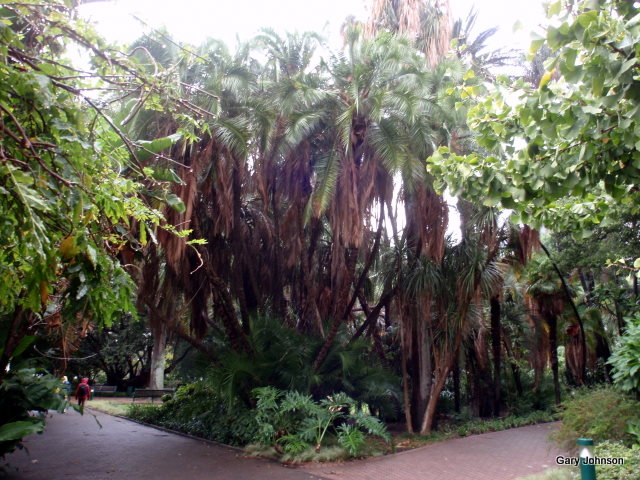
Camphor Avenue in Kirstenbosch Gardens. The four of us hired a taxi for the day. We started our tour here and could have spent all day in this garden at the foot of Table Mountain on the sunrise side. We all commented that this is as beautiful as any garden we have visited anywhere. Leonard: We were thinking you would have enjoyed this. The weather was a little threatening but pleasant and improving.


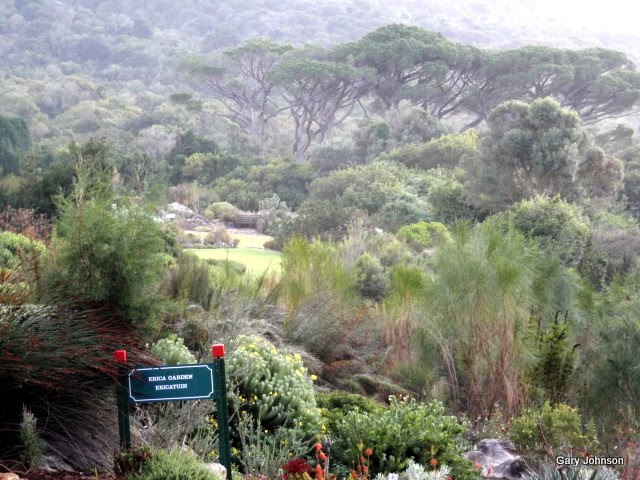
Erica Garden in Kirstenbosch. Photos didn't do it justice and I had a 'low battery' indicator. The three birders with me added to their life-lists.


African "Jackass" penguins--named for the noise they make. Originally from Antartica, a couple of pair lost their way and have multiplied into thousands on nearby islands. Debbie thought, they sure are cute!


Cape of Good Hope. You see the Atlantic Ocean--behind and to the left of the rock is the Indian Ocean.


Cape Hope 'scenic walk'. We had our driver drop us off here and then we hiked up this trail (see the people on top?) back to the vista point--about an hour.

Florence took this to prove that I was along, also.


Cape of Good Hope.
Site of many, many shipwrecks.


Looking south toward Antartica.
Only about 6000 km.


Beach from Good Hope coastal trail.


Looking across Hout Bay at sunset, Cape Town beyond hills.

...to be continued.

Sunday, May 1, 2011

DE CAPE TOWN RACES

Toto, this can't be Swaziland, anymore!
We left the confines of Swaziland and after two days of travel, we found ourselves not only in civilization, but in the midst of fellow Americans--for the start of the International Friendship Run on Good Friday, and the Old Mutual Two Oceans (half) Marathon on Easter Saturday.
In short, it was a wonderful vacation!


A view of Mouille Point about one-fourth into the Friendship Run which was a flat, fun run.
Seventy-six nations were represented, 196 Americans were registered--most, apparently working in Africa.


The International Friendship Run was along the coast of Granger Bay, then turned in here at Green Point Lighthouse (1842) and Mo is streaking toward the Cape Town Stadium.


This is not the start gun but Debbie admiring some sculpture near the waterfront. After the race we enjoyed a festive, international ambiance in very pleasant weather.


Am I hallucinating? Now this is First World! You better believe we dropped a few rand here--real ice cream.


This looks like a good place for lunch. The race finished at Victoria and Alfred Waterfront after circling one of the World Cup soccer stadia and a walkway along Table Bay. Notice Table Mountain in the background with no cloud cover.


Seafood for lunch after a good race--under an umbrella with a good South African wine.
(Apartheid is a thing of the past in 'the rainbow nation', but notice the faces around us and you'll see it exists de facto.)


Table Mountain above Victoria and Alfred Bay. For our first two days (our racing days) there was never a cloud in the sky.
The red guy on the right is made of Coca Cola packing boxes--compare his size to the people in front of him.


We're a long way from home, but only 6131 km from the South Pole.


The Vineyard Inn in Newlands where we stayed for our races. The style is Dutch Colonial and had beautiful grounds and we had a beautiful, modern room, and delicious meals. Newlands is on the back- or east-side of Table Mountain and very pretty. Over five million people are in the metropolitan area which surrounds Table Mountain and is made up of many suburbs.


Po nearing the finish line with 14,200 others. After running "The World's Most Beautiful Marathon", we finished in the stadium of the University of Cape Town. I was seventh in my class of 54. My time would have been faster if the race had been less dense--I was hemmed in by 14,000 other runners trying to funnel through narrow streets--in the dark for the first hour.


Enjoying the rewards of the finish after the race. Table Mountain still has no clouds, but we have other things to do.
End of race days. From here, we change hotels to be nearer downtown and other attractions.
I took a total of nearly 300 pictures so I'm sampling in two posts.
...to be continued.

Sunday, April 17, 2011

GARY'S TRAINING CENTER

We've scheduled our trip to Cape Town beginning Wednesday, so don't expect any posts for a couple of weeks. To get you through, I'm publishing pictures of Mabuda Farm--site of my training trails, and a recent hike with Mo. I trust you will find them unusual because it is an oasis, or even an apparition, in this area of poverty in the mid-veld. The house is over 100 years old, from the Colonial period, now owned by a white physician who employs many Swazis for operation of the largest dairy farm in the kingdom. It appears to be something from an Agatha Christie novel.


These pictures were taken from the cow trails when we hiked a week ago. Views into the valley...then Mo takes a break from birding, then points to over the ridge where we live.
I expect these pictures to surprise you, but note that they are not typical of any other place we've seen in the kingdom.


Click to enlarge.


Back in two weeks.


Thursday, April 14, 2011

THE SWAZI UPRISING

This is a quick post just because the situation here suggests reassurance of our well-being.
The “April 12 uprising” has come and gone. The only sign of anything different in this area was a squad of ‘peacekeepers’ in the middle of the street near our town center, and a strange silence—almost eerie, knowing the facts—which was also noticed by another PCV. Part of the fizzle was because the Prime Minister declared, last week, that any demonstrations would be illegal, and so there were numerous peremptory arrests. Those who did demonstrate were met with water cannon, tear gas, batons, and rubber bullets. …That, and the fact that Swazis operate on APT (African People Time) which means that the Tuesday uprising might still manifest tomorrow. There are continued rumblings that the police action has merely pushed things under the surface and the uprising will erupt again on the King’s birthday anniversary next week. And I’ve just read a lengthy statement by the Swazi Solidarity Network which blames the public for not getting involved, not taking action, and other things—forcefully stated—that I dare not repeat here.
There were hints that other communities might have demonstrated, but we feel that our quiet corner of the kingdom was never in question. We are fortunate (well, unusual) in that we have rapid access to the internet.
Some of you accessed the New York Times article; others know the facts as well as we do. So just briefly:
King Mswati is one of the richest men in the world; 70% of the nation live on less than US$1/day.
The nation is run under “emergency rule”; political parties are banned, appointments are through the absolute monarchy.
Individual rights are determined through the inkhundla system (see above) and corruption is reportedly rampant.
HIV is 26%; unemployment 40%; revenue down 60%;
57% of wealth held by richest 20%; 4% of wealth distributed among poorest 20%
The king supports his 14 wives in an opulent style and is planning an extravagant celebration for his anniversary on the throne.
When approached with complaints from within his kingdom, the New York Times reports that the king responded with these inspiring words to his public, “Work harder and sacrifice more”.

Sunday, April 10, 2011

TWO POSTS FOR THE PRICE OF ONE

Woman’s rights, Swaziland Style (by guest writer, Debbie)

We have been in Swaziland about ten months now and it still shocks me how half the population doesn’t have any voice. Our Swazi sisters are a beautiful and stoic group of women. They work hard; digging ditches for new water pipes, plowing the fields, washing the laundry, taking care of the children, cooking the food, and on and on and on. Many of the children are being brought up by the GoGos (grandmothers) as their mothers have died of HIV/TB. A whole population of what would be mothers and fathers have been lost here as treatment for HIV did not find its way to developing African countries until about 6 years ago. But I digress. Gary and I always notice when a male is parenting as it is so unusual here. Gary has caused quite a stir on campus “doing woman’s work”, sweeping and even doing the laundry when I didn’t feel well one day.

Women are not allowed to enter into contract or to have property except for some specific household goods like a cooking pot. So how do women start a small business? If a woman is widowed here, the property goes to the husband’s family, and her father, regardless of her age, makes all the legal/contractual decisions for her. If she divorces her husband for, say, physical abuse, her children are taken from her and given to the father’s family. No wonder the divorce rate is so low; who would want to lose their children? An attorney told us a story regarding a woman who did manage to have a successful business. She dutifully gave her profits to her husband who in turn used it to pay “Lobola” (number of cows given to the father for the right to marry a daughter) so he could take a second wife. She had no legal recourse. If there is not enough money to buy school uniforms or to pay school fees, it is the girls who will stay home. I can go on and on.

What makes you want to weep is the loss to the country of all the talent and creativity that is wasted by keeping half of the population as second class citizens. It is the women in most countries that fight for social issues such as good schools, healthcare and a future for the kids. To a large measure their voices are silent here as I expect it is in many African countries.

We women who live in the United States are blessed, indeed. I am most grateful that our daughters and granddaughters will have opportunities that women in many parts of the world only dream about. My daughter and I used to jokingly tease my son by singing Helen Reddy’s “I am woman” to him in the car. I only now really understand the significance of the lyrics. It is my dream that as I continue my volunteer “career” here and in the states that I can somehow volunteer in such a way that perhaps just one woman in a developing country can sing this song loudly and proudly. Anyone want to join me? Watch me grow, I am strong, I am invincible, I am woman.

And now, for something totally different: (by Chief blogger, Gary)

This is a primary school campus so there is probably enough material each day to create a post if I had the time. Attending to Very Important Work, however, prevents that. But let me tell you a little about an event last week:

Friday was the final day of this term; exams were the previous week and much sports activity last week. Being a residence school, the kids were excited and keyed up in anticipation of leaving for home. The schedule was unstructured and the library is a comfortable, secure and interesting place to visit, thanks to the supervision of the kindly librarian. Being primary students in this situation, I was constantly going around pouring cold water on volatile situations as they arose, my attention being called by hearing screams in various sections of the library. After responding to one such “emergency”, I heard a scream from clear across the room. This one was different: sustained and meaningful. Investigating the source, I found one of my “favorites” on the hard wood benches with her head—up to and including her ears—firmly wedged between seat and back-rest. My first instinct was, of course, to push her head back out. It wouldn’t budge and I felt her pain. Next, I attempted to lift the back slat while pushing down on the seat. It is heavy material and nothing gave; but while in that position, I looked around and realized that everyone around me was deaf. They couldn’t hear my frantic voice requesting help, and my hands were occupied so I couldn’t sign. Making no progress, I reverted to the original plan and forcefully pushed her head out, perhaps using her ears as a spacing mechanism. Talk about a painful delivery. As soon as she was extricated, three mothering, older students led her away before I had the opportunity to check her out. So I convened court on the spot and interrogated the most likely suspect who, of course, pleaded innocence. The case was dropped for lack of evidence. A short while later, I found the victim (a genuine cutie) on the floor of the pre-reader section, in the fetal position, sucking her thumb. I signed, “How are you?” and only got a morose look from her. Later in the day, she was up and about with ears attached and as cute and happy as before.